You’ve got five minutes to doors.
Lighting is programmed. Cues are clean. Then someone flags an issue...
...a fixture isn’t responding.
Then another.
Now you’re chasing signal instead of running the show.
You start tracing it back. Is it a bad cable? Is it interference? Is it that one wireless node that’s been “mostly fine” all week?
That’s the problem with control systems. When they fail, they don’t fail quietly.
You need an asset that can handle complex routing, reduce cable clutter, and maintain rock-solid performance in RF-heavy environments.
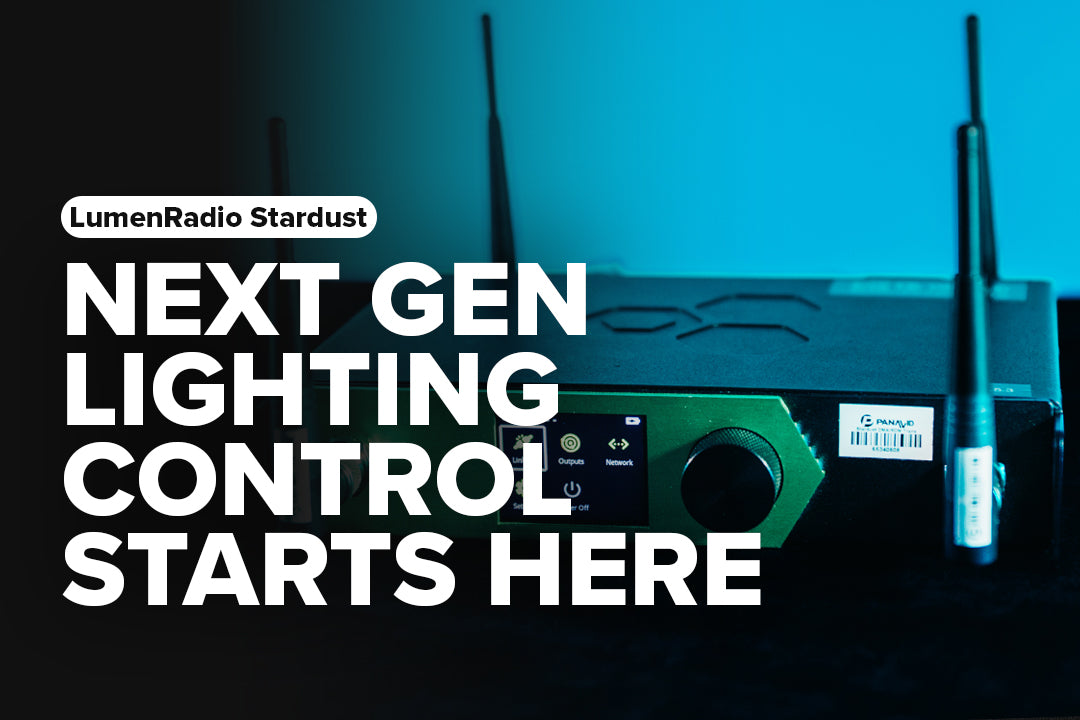
The LumenRadio Stardust Eight Universe DMX/RDM Transmitter has you covered here. It's designed to deliver multi-universe wireless DMX with centralized control and built for demanding production environments.
KEY FEATURES
Meet Stardust
The LumenRadio Stardust is a professional-grade wireless DMX/RDM transmitter capable of handling up to eight universes simultaneously. (They should've called it the lighting spider if you ask me, but I just write the gear highlights.)
It’s built around LumenRadio’s CRMX technology which, at this point, is the standard most crews trust when wireless DMX has to work the first time.
It’s built for productions that require low-latency lighting control across large venues, touring setups, broadcast environments, and permanent installations.
Instead of relying on multiple single-universe transmitters, Stardust consolidates control into a single platform.
Less moving parts in a field that has so many to begin with.

KEY FEATURES
Multi-Universe Wireless Transmission
Stardust supports up to 8 DMX universes over wireless, allowing designers and programmers to manage large fixture counts without running extensive cabling across the venue.
This makes it great for:
Large stage lighting rigs
Multi-zone architectural installations
Touring productions with complex layouts
Each universe is transmitted with consistent timing, ensuring synchronized playback across all connected fixtures. Your lights will be dancing together like Travolta and Thurman.
Whether you’re in a packed festival environment or a multi-room venue, the system is designed to maintain signal integrity.
Need more than 8? Add another transmitter and link them together. Easy as that.
KEY FEATURES
RDM Support for Remote Management
With full RDM (Remote Device Management) compatibility, Stardust enables bi-directional communication between controllers and fixtures.
This allows you to:
Address and configure fixtures remotely
Monitor fixture status and diagnostics
Reduce the need for physical access during setup and maintenance
For large-scale or hard-to-reach installations, this becomes a major advantage.
And safer one at that.
KEY FEATURES
Centralized System Control
The Lumeradio Stardust transmitter acts as a hub for your DMX universes, providing a centralized point for configuration and monitoring.
From a single interface, operators can:
Manage multiple universes
Configure wireless links
Monitor signal health and connectivity
Streamline deployment across large systems
This reduces complexity compared to deploying multiple independent transmitters. One piece of equipment doing the job of several is always a good thing.
Integration & Connectivity
The Lumenradio Stardust is built to integrate. Typical setups include:
DMX over Ethernet protocols (such as Art-Net or sACN) feeding into the transmitter
Wireless distribution from Stardust to multiple receivers
RDM communication for fixture management across the network

APPLICATIONS
Where It Excels
The LumenRadio Stardust Transmitter is especially well-suited for:
Live events and concert touring
Festivals and large venue productions
Broadcast and studio lighting systems
Architectural and permanent installations
Theme parks and experiential environments
Compared to smaller single-universe wireless solutions, Stardust offers significantly more capacity and control—without needing multiple independent transmitters.

A Few Things To Keep In Mind
While powerful, the LumenRadio Stardust Eight Universe system is designed with specific deployment considerations:
It requires proper network infrastructure
Since it typically relies on Ethernet-based protocols, your network configuration (switches, routing, addressing) plays a key role in performance. Sort this out beforehand.
Wireless performance depends on environment
Like any RF system, obstacles, interference, and antenna placement can impact range and stability. Proper planning is essential for optimal results and no interruptions.
Stardust works best within a CRMX ecosystem.
You’ll get the most out of it when paired with compatible receivers and fixtures. Mixing ecosystems can work, but this is where it performs at its best.
FINAL THOUGHTS
The LumenRadio Stardust isn’t just a wireless DMX tool—it’s your mothership for modern lighting systems.
Think of Stardust as the hub. Everything else plugs into its workflow.
It’s not about flashy features. It’s about consistency. Stability. Knowing that your data is going to get where it needs to go...every time.
It gives lighting designers and technicians the ability to scale up while maintaining the reliability required in professional environments.
For teams moving beyond single-universe wireless solutions, Stardust provides a clear path forward: more capacity, more control, and fewer constraints.
If your productions are growing in size, this is a product that keeps everything connected, consistent, and cozy.
If you’re ready to explore the universe together…
Let’s talk gear.