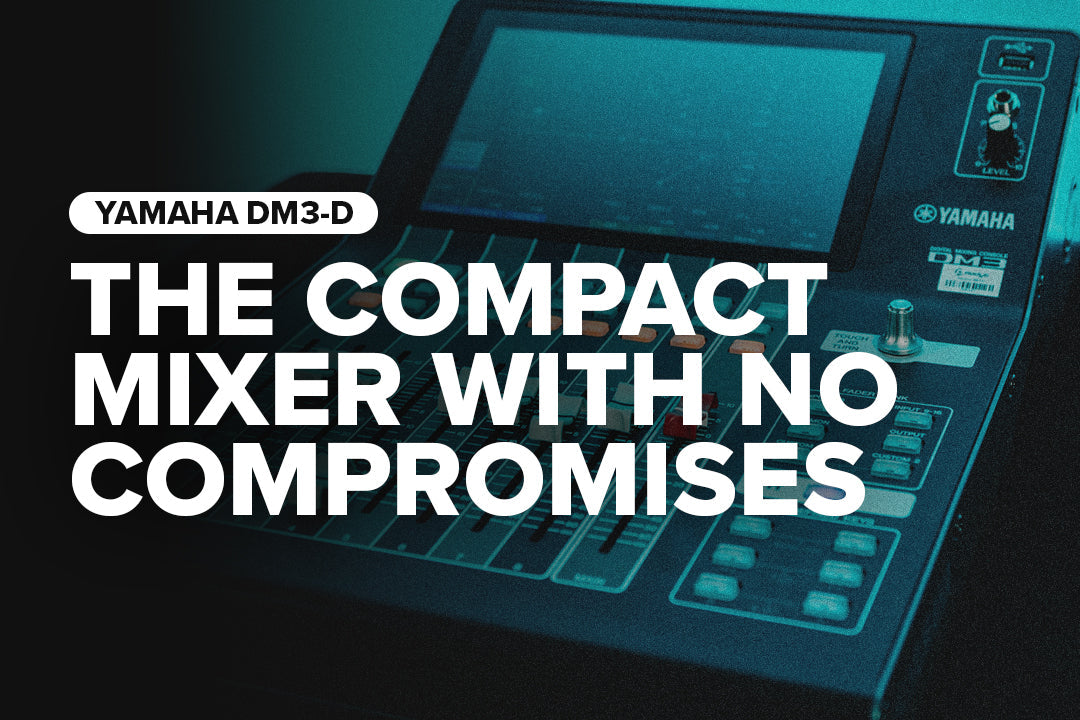
In the world of modern live sound and hybrid production, compact often used to mean compromise. Leaving you with that nagging feeling that you’re “just getting by” instead of truly mixing at a professional level.
The Yamaha DM3-D doesn't ask you to make that trade.
This isn’t a “small console for small gigs.” It’s a fully loaded digital mixer that just happens to fit in spaces where older systems would never dream of going. Whether you're running live FOH, handling corporate AV, or building a streaming rig that can't afford a hiccup, the DM3-D is built to remove friction — not add it.
What We'll Cover
- What's actually packed inside the Yamaha DM3-D
- How the touchscreen-driven workflow changes your show day
- Why Dante networking is the real story behind the "D"
- Where the sound quality holds up under pressure
- Who this console is built for and where it's maybe not the right tool
- Where to get your hands on one
KEY FEATURES
Built Small, Designed to Act Big
At first glance, the Yamaha DM3-D is almost deceptively minimal. A small surface, 9-inch touchscreen, and a clean layout with 8+1 fader control.
But underneath that simplicity is a full-featured engine:
16 mono mic/line inputs + stereo input
6 mix buses + stereo bus
2 matrix buses for flexible routing
Dual FX engines with high-quality processing
96 kHz processing for high-resolution audio
Dante networking for scalable system integration
That Dante capability alone pushes the Yamaha DM3-D far beyond “compact mixer” territory. It becomes part of a larger ecosystem rather than a standalone box.

KEY FEATURES
Workflow That Moves Fast (and Stays Out of Your Way)
Here's what matters on show day: how fast can you go from power-on to passing audio? With the DM3-D, faster than you'd expect from something this size.
Yamaha leaned into a touchscreen-driven workflow paired with a single "Touch & Turn" encoder. Fewer physical controls, fewer layers of menu-diving, more direct access to what you actually need.
Key workflow features include:
Quick Pro Presets for instant channel setup
Scene memory for fast show recalls
Flexible patching for complex routing without repatching cables
Remote control apps for tablets and mobile devices
In real-world use, it behaves less like a traditional mixer and more like a configurable audio hub that adapts to the gig in front of you.

KEY FEATURES
Dante Integration: The Real Backbone of the “D” Model
The “D” in DM3-D isn’t just branding. It’s the defining feature.
With integrated Dante networking, the console can send and receive multichannel audio over Ethernet, making it a natural fit for modern distributed systems. Whether you’re feeding stage boxes, recording rigs, or broadcast systems, the routing flexibility opens up a lot of possibilities without adding external hardware.
For smaller venues moving toward networked audio, this is a big deal. It reduces clutter, simplifies setup, and allows the console to sit cleanly in both standalone and system-based environments.

KEY FEATURES
Sound Quality That Feels Big
One of Yamaha’s strongest advantages has always been conversion quality and processing consistency, and the Yamaha DM3-D continues that trend.
Even at higher channel loads, the console maintains:
Clean gain structure with low noise floor
Transparent EQ and dynamics processing
Responsive effects that feel mix-ready rather than “added on”
The internal processing at 96 kHz helps keep latency low while preserving detail—especially noticeable in vocals, acoustic instruments, and broadcast-style mixes where clarity matters more than sheer loudness.

KEY FEATURES
Streaming, Recording, and Hybrid Workflows
Where the Yamaha DM3-D really starts to stand out is in hybrid production environments.
With USB audio interface functionality and multitrack recording support, it can easily bridge live sound and content creation:
Direct USB recording to DAW
Multitrack capture for post-production
Stereo streaming output for live broadcast
DAW remote control integration
For venues, churches, and content-driven production setups, this removes the need for separate interfaces or external recorders in many cases.
KEY FEATURES
Real-World Take: Who It’s Actually For
The Yamaha DM3-D isn’t trying to replace a flagship touring console. It’s not competing with massive festival rigs or high-channel-count broadcast desks.
No console does everything, and the DM3-D isn't trying to. A few things worth knowing before you build your show around it:
- 8+1 physical faders means larger channel counts live on the touchscreen, not under your fingers. If your engineer is used to grabbing a physical fader for every input, there's a short adjustment period.
- 16 mono inputs is plenty for a corporate breakout, a house of worship, or a touring B-rig — but it's not the console for a 40-channel festival stage. Know your channel count before you book it.
- 2 matrix buses cover most zone and feed routing needs, but if you're running a complex multi-zone system with heavy show control, you'll want to map that out ahead of time rather than discover the limit on show day.
None of this makes the DM3-D the wrong choice. It makes it the right choice for a specific kind of show. A mid-size corporate general session streaming to a remote audience, for example, is exactly the workflow this console was built to carry: touchscreen-driven scene recalls between sessions, Dante feeding the broadcast package, USB capture running in the background as a safety net. That's the DM3-D doing what it does best.
Where It Excels
- Small to mid-size venues
- Corporate AV systems
- Houses of worship
- Touring B-rigs
- Streaming and hybrid content setups
- Mobile engineers who need speed and reliability without a truck pack
It’s built for operators who care more about workflow efficiency than menu complexity, and more about consistency than endless feature stacking.

FINAL THOUGHTS
The Yamaha DM3-D is one of those consoles that quietly reshapes expectations.
It doesn’t overwhelm you with physical controls or massive channel counts. Instead, it focuses on speed, clarity, and system integration.
In a lot of ways, it reflects where live audio is heading: less standalone gear, more connected systems, and workflows that blend live sound with production and streaming.
If you're looking for a compact digital console that doesn’t feel like a downgrade, the DM3-D sits in a very strong position.
It’s not just smaller. It’s smarter about what it chooses to keep.